
Maamoul
a reflection on holiday traditions and a guide to making maamoul

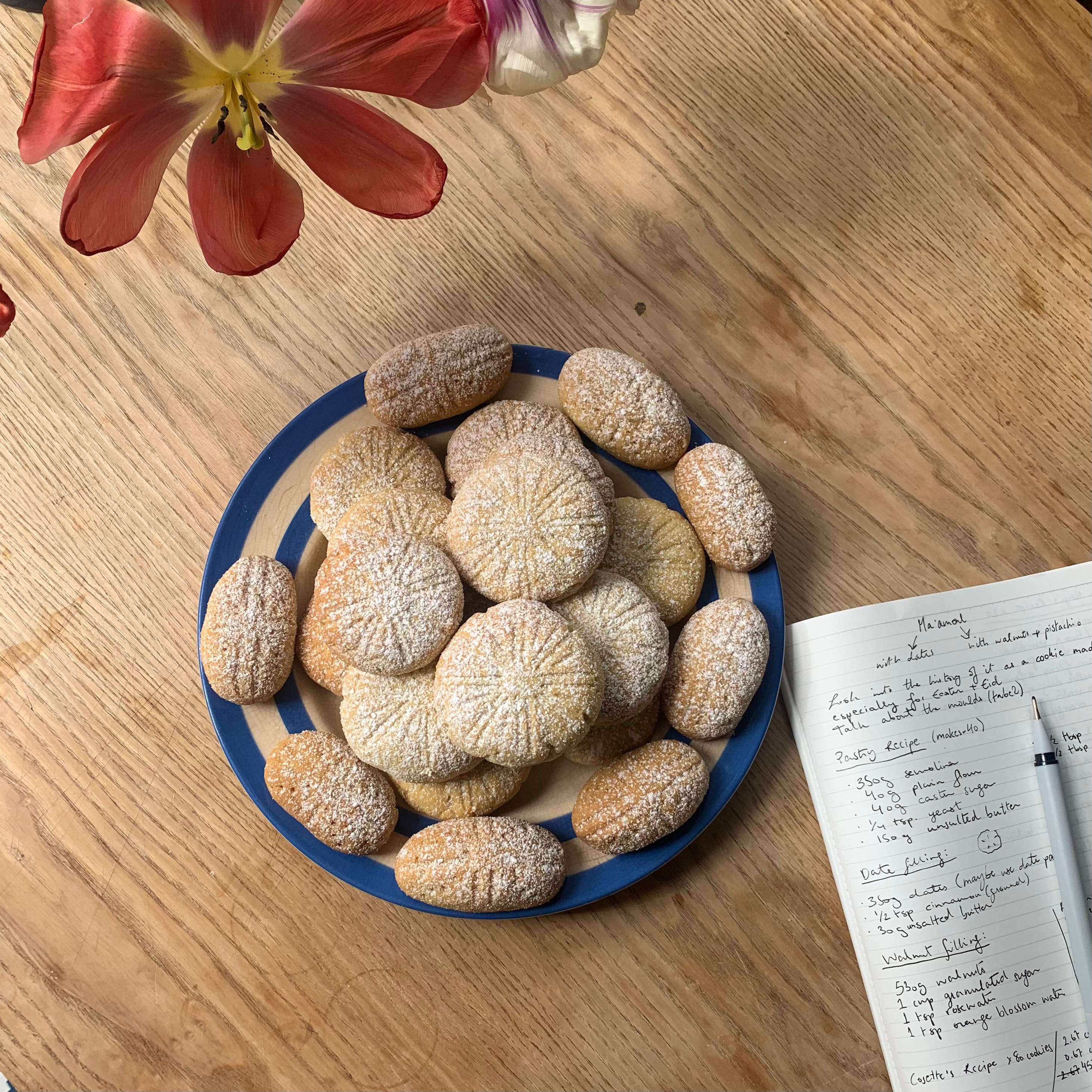
Welcome to the Lebanese Larder, where I share with you recipes and notes on Lebanese culinary traditions that I explore from my home in London, with guidance over the phone from my mom and aunties.
I suppose starting this came from a longing for familiar comfort foods and a desire
to connect more deeply to my roots back in Lebanon. Naturally, it made the most sense to do this through cooking, sharing what I make with friends and, well, everyone online.
Learned through oral traditions, recipes are passed down from grandmother to mother and mother to daughter. Over the years, they may be slightly tweaked. These recipes and knowledge are sacred to the matriarch of a family; it would be insulting
to alter them in any other way. When I consider this, I think of how I want the recipes I share to be a clear reflection of my grandmother's recipes and her spirit, as well as the knowledge that has been passed down through many generations by the women
in my family. This means no substitutions and no shortcuts, as it is the sometimes lengthy process of these dishes that makes Lebanese cooking so special.
With the celebration of Easter and Eid al-Fitr this past month, and having indulged
in many lovely hot cross buns, I found myself reflecting on the holiday traditions my Lebanese family would partake in. It only felt right that I start this exploration with
a holiday classic like Maamoul, and how the process of making this cookie perfectly represents Lebanese family dynamics through culinary traditions.
All about maamoul
Like Italian colombo and British hot cross buns, maamoul is a Lebanese holiday staple, usually associated with Easter and Eid al-Fitr. It would be amiss to visit a house during the holidays whose hosts do not extend a tray of maamoul in your direction as soon as you walked through the door. A humble and unassuming cookie, whose name means ‘to make’, maamoul has a buttery, crumbly semolina shell, adorned with different patterns resembling sunbursts, or for Christians, patterns symbolic of Christ’s suffering. This fact might not whet one’s appetite. However, the delightfully sweet filling made of either dates, walnuts, or pistachios, flavoured with cinnamon, rose water, and orange blossom water, certainly will.
Traditionally, the task of making these cookies is a collective effort done in a relative’s kitchen, a few days ahead of the holidays. Each person has a part to play in this almost performative act around the kitchen table: one shapes the dough, one shapes the fillings, one fills and pinches the cookie closed and passes it along to the decorator. Underneath the cacophony of teasing and gossip, everyone takes deep pride and concentration in their role.
Although the women in my family didn’t gather every year to make maamoul by hand, they gathered nonetheless in celebration. There would be excited conversations in my Teta’s kitchen, with my aunts talking over one another about who they were buying their cookies from this year. At some point, they would all collectively decide on one local bakery to purchase the cookies from.
My mom, who is from Massachusetts, was raised in quite a typical New England household; and up until she married my father, never celebrated Eid and most probably had never heard of maamoul. However, she fully embraced it in the years
we lived in Lebanon, negotiating in broken Arabic how many kilos of maamoul she and my Teta should purchase together. Someone always diverted from the bunch
and insisted on buying cookies from their trusted maamoul maker. I can still hear the bickering of whose cookies were the best over cups of ahwe, as we made the obligatory rounds to my relative’s houses over the holiday period.
Historically, maamoul can trace its roots back to the Egyptian ‘kahk’. This ancient baked good is depicted in paintings, located both in the ruins of Memphis and Thebes, dating to the Pharaonic era. The beginning of the cookie’s connection with Eid can be traced back to the Ikhshidid dynasty1, governors of the Abbasid Caliphate, with the tradition continuing under Fatimid Caliph Al-Aziz (909-1171 AD).
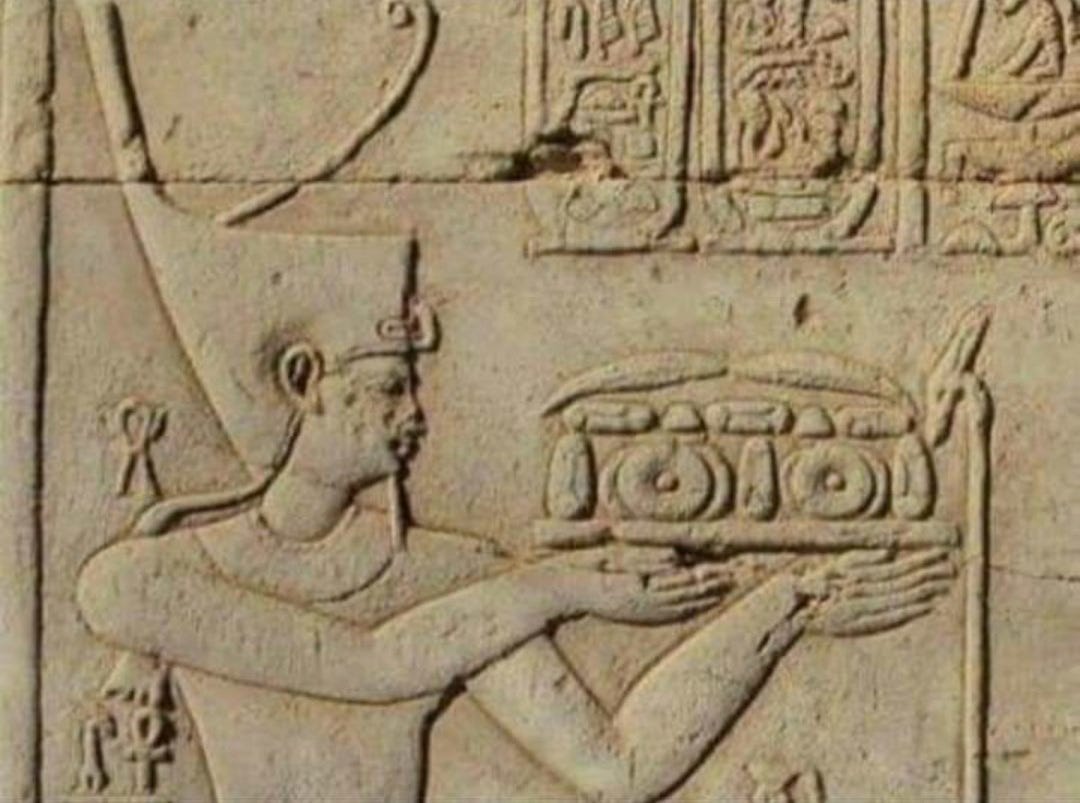
Originally made and distributed throughout the palace to courtiers, officials, and guardsmen, the tradition became so popular that it required a department, ‘Diwan al-Fitr’, dedicated to producing cookies for the public. On the first day of Eid, people would march to Bab El-Nasir and then perform the Eid morning prayer. Following
the prayers, cookies would be distributed by the state. They were piled high on an expansive table, marked with phrases such as ‘kol was oshkosh’ (eat and be thankful) and ‘bel shokr tadoom al naem’ (gratitude preserves blessings).
Writing this, I am transported to memories of my childhood during Eid. My parents would wake us before dawn. I’d try to rinse the haze out of my eyes, only for sleepiness to wash back over them as I changed into a carefully thought-out outfit I had picked out at the store with my mother two weeks before. My dad would come downstairs wearing one of his many suits, his scent filling the air. He took great pride in these suits, buying them tailor-made from a boutique that now no longer exists, exclaiming that department stores don’t make them the same. I think of this when I think of Eid because the night before, he would always gather us to decide which suit he should wear, fussing over the knot in his tie as he didn’t want to resemble the elderly men
in the day3a2.
My siblings and I would get in the car with him, where we’d make our way to the day3a, the sun slowly rising behind us. I always thought my mother was lucky on these mornings because she could stay behind, escaping the polite small talk so early in the morning. She would be busy preparing the house for guests. This, included a carefully laid out tray of maamoul and chocolates that she forbade us to touch. It, was for guests, after all.
We’d arrive at my dad’s family home, my sister and I attempting to make ourselves scarce until our Teta found us and sent us off to help my aunts with one of the many chores. My dad, his brothers, all of their sons, and the rest of the men in the village, would make their way to the mosque. Being the only girls in the immediate family,
my sister and I would continue helping my aunts and Teta set up the house for guests. Maamoul, chocolates, and candies were piled high on trays, with a large pot of ahwe3 alongside everything would be laid out on tables by the gate entrance.
As the morning prayer concluded, the men would make their way, often reminding
me of fish swimming upstream, marching throughout the village in celebration.
I would stand to the side with my sister, shyly handing out maamoul as my Auntie Iman made conversation with distant relatives who passed by, waiting for my dad
and brother to appear from among the crowd. Looking out at the street, women
of each household would also be waiting at the entrance of their homes, excitedly offering their sweets with words of kindness/celebration saying ‘kol 3am w enta/i bikhair’ / ‘I wish you goodness every year’4.
It never occurred to me that perhaps we greeted people this way on the morning
of Eid because it was passed down for generations from the Fatimids or Ottomans, who once patrolled the valley and mountains that belonged to my ancestors, perhaps unknowingly. We use the original Coptic designs of sunbursts on our maamoul now, instead of the propagandistic phrases used by the Caliphates. Still, maamoul is always served with good tidings and warm wishes for the future.
So, it is not necessarily tradition that drives me to attempt making my own maamoul.
I am sure if I called my mom, she would tease me by saying I should just find a Lebanese bakery to purchase some from, instead of making my life more difficult.
But I like the difficulty of it, understanding why it’s a two-day process, testing my patience. I also know whatever I buy will not taste the same as my memory, and I
am determined to recreate that. Alongside that, there is also the sense of ritual that making them provides. Being part of the diaspora now, separate from family and
these yearly traditions, and hearing secondhand what is happening to my home
and neighbours, cooking is one thing I can control and have agency over in some way.
Shaping the cookies:
Traditionally maamoul is shaped using a tabe’, a wooden mould engraved with patterns that decorate the cookies, but you can make patterns using a fork.
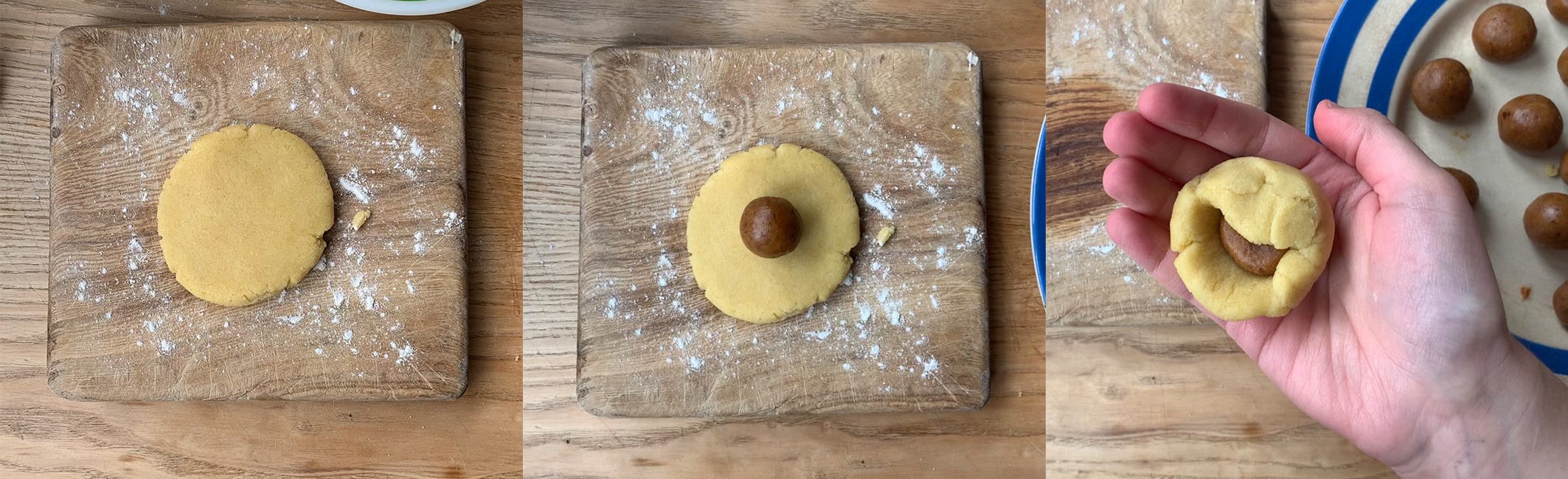
Take a walnut-sized piece of dough and shape it into a hollow cup or flatten it into
a patty (make sure it is not too thin, you don’t want it to break) placing the date or
nut mixture in the middle and pinch the dough closed around the filling, shaping
into a ball.
If using a tabe’, lightly press the dough into the mould. Inverting it, tap the tabe’ against a hard surface to release the cookie. Place on a baking tray and continue
this process for the rest of the pastry.
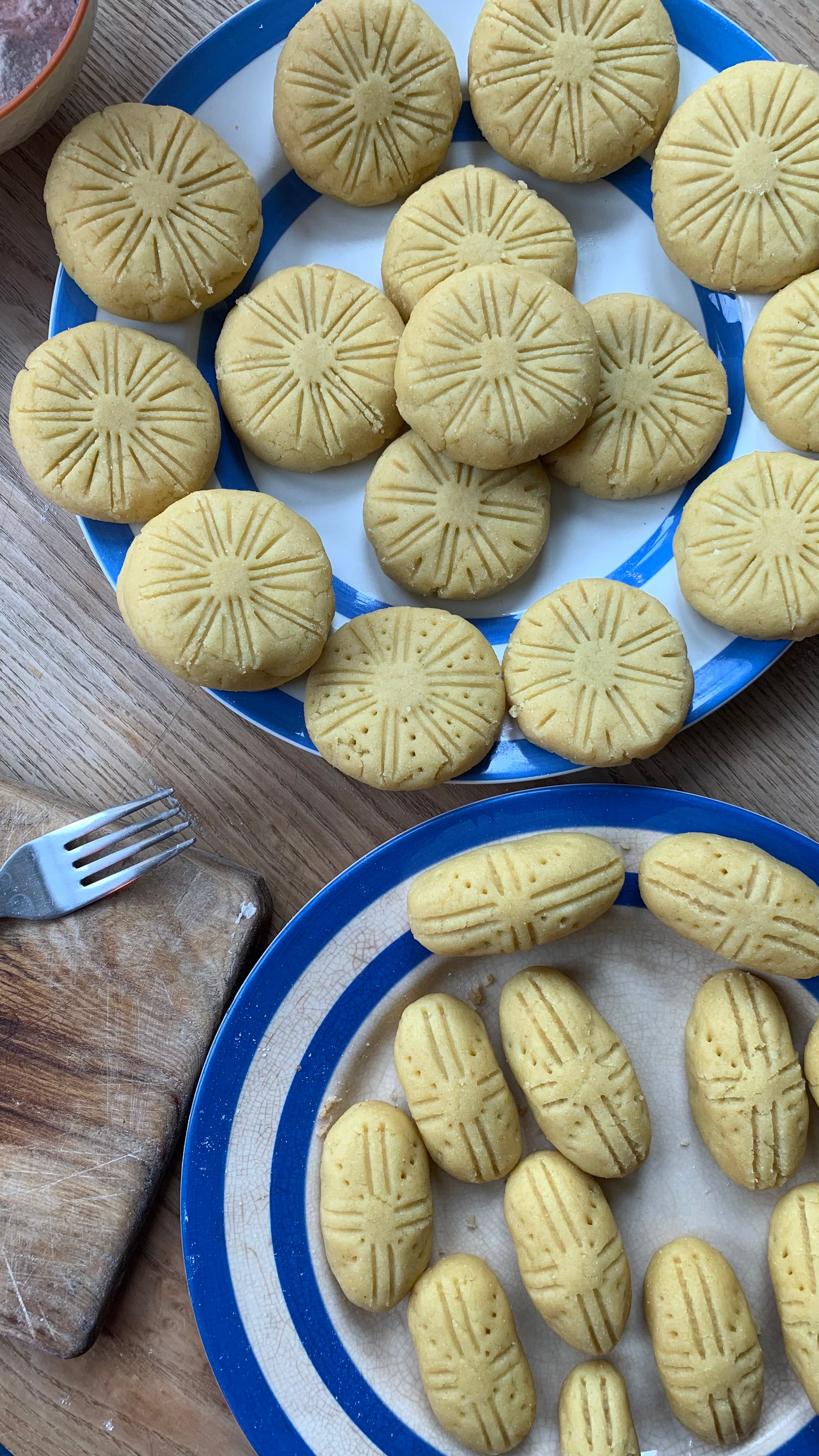
If you’re not using a mould, slightly flatten the filled dough into a patty or, for
the nut-filled cookie, an oblong oval. Add indentations using a fork. I followed the traditional design of a sunburst for the date cookie and one resembling a cross on
the oblong nut cookie.
For the pastry:
250g unsalted butter
300g semolina flour
200g coarse semolina
2 tbsp caster sugar
137g plain flour
Half a packet of active yeast
1 tbsp orange blossom water
1 tbsp rose water
3 tbsp of water or milk but I added more gradually, probably 100ml worth,
until the dough came together like shortcrust dough, not too wet.
Date filling (~10 cookies):
175g pitted dates (Iwould recommend using date paste which can be found in most Turkish or Middle Eastern grocers)
½ tsp cinnamon
15g unsalted butter, melted
Melt butter and add to bowl of dates. Combine well, using a fork or your hands.
Walnut filling (~10 cookies):
80g walnuts
25g granulated sugar
½ cinnamon
½ tsp rose water
½ tsp orange blossom water
Blitz this together in a food processor, until the walnuts are broken down to
a medium/fine consistency.
Method:
• Melt the butter in a medium- sized saucepan. Once melted, add in the semolina and mix until fully incorporated. Leave this mixture to sit overnight with a lid on. Leaving it overnight allows the semolina to fully absorb the butter, which I believe enhances the taste and texture of the cookie.
• The following day, reheat the semolina mixture over medium-low heat, loosening it up a bit. Transfer this to a large mixing bowl.
• Sift in the flour, yeast, sugar, and flower water and mix until incorporated.
• Gradually incorporate water/milk, allowing it to fully incorporate before adding more, either using a mixer or your hands. This ensures you don’t add too much liquid. You’ll want a dough that’s damp enough to form into balls, similar to pie crust.
• Preheat the oven to 170C. Shape the cookies following the method above, placing them on a parchment lined baking tray.
• Bake for about 20-25 minutes until the tops of the cookies are just barely golden.
• Once cooled, give them a good dusting of icing sugar.
10th century; of Turkic Mamluk origin, ruling Egypt and the Levant from 935 to 969 AD.
This refers to the Arabic term for ‘village’, where one’s family is from.
Lebanese style coffee made in a rakweh (pot), sometimes referred to as Turkish coffee.
In Arabic script: ‘كل عام و أنتم بخير’